PFAS in France: 10 things to know
The French ban on PFAS in clothing and footwear, in force since January 2026: the ten key points and the operational summary.

France has introduced legislation banning PFAS (per- and polyfluoroalkyl substances) in textile products for clothing and in footwear.
The rules are set by Law no. 2025-188 of 27 February 2025 and Decree no. 2025-1376 of 28 December 2025, and the first bans have been in force since January 2026.
As many of your supplies are destined for or pass through the French market, we want to help you tackle the change with clarity. Below you will find a ten-point summary of the essentials and a link to a more comprehensive operational summary.
Ten points — the 10 things to know
- From 1 January 2026 the PFAS ban applies to all textile products for clothing and to all footwear intended for consumers.
- From 1 January 2030 the ban extends to all textile products, including those intended for professionals (with exceptions for essential uses and industrial technical textiles). Professional footwear, however, remains excluded.
- What is covered: textile garments, mixed leather/fabric garments (the textile part is checked), clothing accessories (ties, bow ties, belts, scarves, foulards), textiles imitating leather, all footwear (including leather).
- What is excluded (until 2030): garments and accessories made entirely of leather, leather goods (bags, clutch bags), fabric watch straps, and products intended exclusively for professionals.
- Three cumulative thresholds on the finished product, all of which must be met: total fluorine ≤ 50 ppm, individual PFAS ≤ 25 ppb, sum of PFAS ≤ 250 ppb. The thresholds are measured on the homogeneous material (e.g. lining, outer layer, trim assessed individually).
- “Open” list: the law applies to all PFAS as defined by the decree. There is no closed list of substances, nor is one planned.
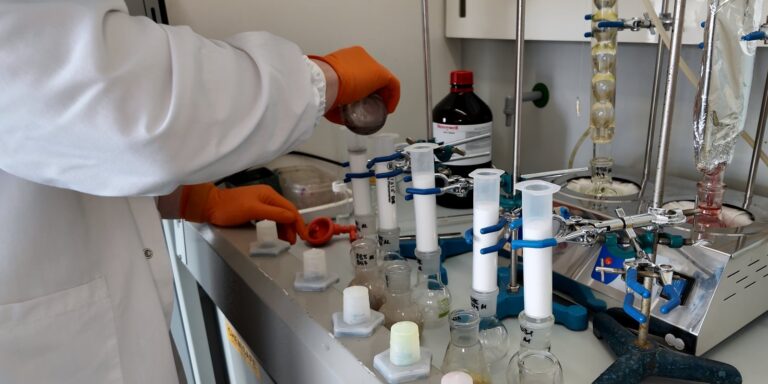
- How to demonstrate compliance: there is no harmonised method yet. Any technically valid method is accepted; for textiles, the reference standard is EN 17681-1/-2:2025. Supplier documentation certifying the absence of PFAS is also valid evidence.
- “Placing on the market” = first making available. Products already on the shelves or in stock before the ban can continue to be sold; the European limit (REACH / POP, e.g. PFOA) always remains applicable.
- Sell-off of stock: a product manufactured before January 2026 may be placed on the market within the following 12 months. Note: this period applies to finished products, not to raw materials or components (a roll of PFAS-treated fabric cannot be used to make garments after 2026).
- Recycled content exemption: provided for products containing more than 20% post-consumer recycled material (by total fibre weight), on condition that no PFAS are added in the process and that traceability and origin can be demonstrated.
Detailed document
To find out more about scope, thresholds, analytical methods, exemptions and stock management, we have prepared a downloadable operational summary: PFAS operational summary (PDF, in Italian).
Our commitment
Lanartex is already working to offer suitable and therefore accredited services to support our customers through the reorganisation required at this historic stage.
For any questions you can contact customer service:
- On WhatsApp Business: +39 379 223 4921
- Or by writing to: labo@lanartex.it
We are available for quick, no-obligation clarifications.
Browse the full list of available tests, with methods, quantities and accreditation status updated in real time.
Go to the test list